| Size | Price | Stock | Qty |
|---|---|---|---|
| 10mg |
|
||
| 25mg |
|
||
| 50mg |
|
||
| 100mg |
|
||
| 250mg | |||
| 500mg | |||
| Other Sizes |


| Targets |
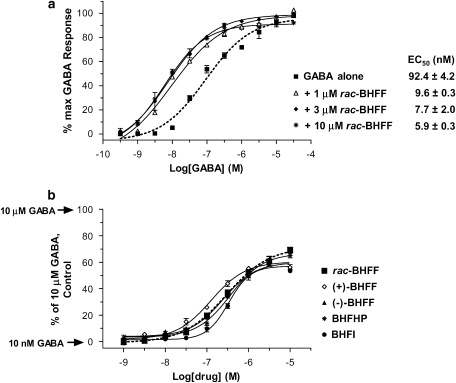
rac-BHFF's primary target is the GABAB receptor, a G-protein coupled receptor (GPCR) that functions as a heterodimer composed of GABA-B1 and GABA-B2 subunits. As a positive allosteric modulator, rac-BHFF binds to a site distinct from the orthosteric (GABA) binding site and enhances the receptor's response to GABA without directly activating the receptor. It increases the potency of GABA by more than 15-fold and enhances its efficacy by over 149%. rac-BHFF also shows agonist activity at the human GABA-B receptor with an EC50 of 1900 nM in HEK293 cells.
|
|---|---|
| ln Vitro |
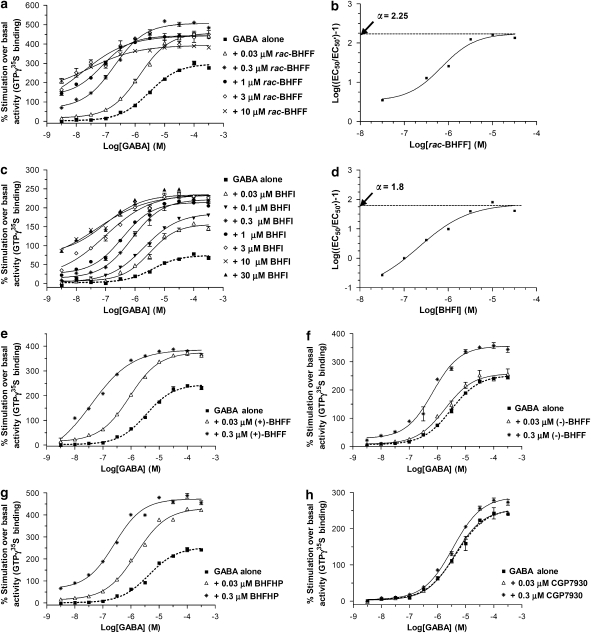
In vitro, rac-BHFF acts as a potent and selective positive allosteric modulator of the GABAB receptor. It enhances GABA-induced [35S]GTPγS binding with an efficacy of 149.0%. The compound increases the potency and efficacy of GABA by more than 15-fold and 149%, respectively. It also exhibits agonist activity at the rat GABA-A alpha1beta2gamma2 receptor with an EC50 greater than 100,000 nM when expressed in human TSA201 cells, indicating selectivity for GABAB over GABAA receptors. rac-BHFF demonstrates modest inhibition (12.17%) of SARS-CoV-2 3CL-Pro protease activity at 20 µM and shows some activity against human HDAC6.
|
| ln Vivo |
In mice suffering from stress-induced hyperthermia (SIH), rac-BHFF exhibits anxiolytic-like characteristics [1]. SIH was reversed by rac-BHFF (3, 10, 30, and 100 mg/kg, orally), with a significant effect at 100 mg kg−1 (P<0.001) [1].
In vivo, rac-BHFF exhibits anxiolytic activity and is orally active. The compound is able to cross the blood-brain barrier to exert its central nervous system effects. Its ability to positively modulate GABAB receptor signaling makes it a valuable tool for studying the role of GABAB receptors in anxiety, addiction, learning, memory, and other neuropsychiatric disorders. |
| Enzyme Assay |
The in vitro activity of rac-BHFF as a GABAB receptor positive allosteric modulator is assessed using functional assays such as the [35S]GTPγS binding assay. In this assay, membranes prepared from cells expressing the GABAB receptor (e.g., HEK293 cells) are incubated with [35S]GTPγS, GDP, and varying concentrations of GABA in the presence of rac-BHFF. The potentiation of [35S]GTPγS binding by rac-BHFF is measured to determine its efficacy and potency as a PAM. The compound's ability to increase the potency and efficacy of GABA is calculated by comparing the EC50 and Emax of GABA in the presence and absence of rac-BHFF. Competition binding assays using radiolabeled GABAB receptor ligands can be used to confirm that rac-BHFF binds to an allosteric site distinct from the GABA binding site.
|
| Cell Assay |
For cellular assays, cells expressing the GABAB receptor (e.g., HEK293 cells stably or transiently transfected with GABA-B1 and GABA-B2 subunits) are used. Cells are cultured in appropriate media (e.g., DMEM with 10% fetal bovine serum) and treated with various concentrations of rac-BHFF (typically ranging from 1 nM to 100 µM) in the presence of a sub-maximal concentration of GABA. The activation of the GABAB receptor is assessed by measuring the inhibition of forskolin-stimulated cAMP accumulation or by using a [35S]GTPγS binding assay. The potentiation of the GABA response is measured to determine the EC50 and efficacy of rac-BHFF as a PAM. For studies on antiviral activity, Caco-2 or VERO-6 cells are treated with rac-BHFF at 10 µM for 48 hours to assess inhibition of SARS-CoV-2 induced cytotoxicity.
|
| Animal Protocol |
Animal/Disease Models: Male NMRI mouse (20-25 g) [1].
Doses: 3, 10, 30 or 100 mg/kg. Management: PO. Experimental Results: The LRR effect was Dramatically increased at subthreshold doses of baclofen of 3 mg/kg and above. In vivo, rac-BHFF is typically administered orally to animal models. The compound can be formulated in a vehicle such as 10% DMSO, 40% PEG300, 5% Tween 80, and 45% saline at a concentration of 2 mg/mL (6.05 mM). For studies of anxiolytic activity, the compound is administered to rodents and behavioral tests such as the elevated plus maze, light-dark box test, or open field test are performed. The effects on learning and memory can be assessed using the Morris water maze or passive avoidance tests. |
| ADME/Pharmacokinetics |
rac-BHFF has a molecular weight of 330.34 g/mol and a molecular formula of C17H21F3O3. It is soluble in DMSO at 50 mg/mL (151.36 mM). The compound should be stored as a powder at -20°C for up to 3 years or in solvent at -80°C for up to 1 year. It has a predicted relative density of 1.232 g/cm3. For in vivo administration, it can be formulated in 10% DMSO, 40% PEG300, 5% Tween 80, and 45% saline.
|
| Toxicity/Toxicokinetics |
Specific toxicity data for rac-BHFF is not detailed in the provided search results. As a GABAB receptor positive allosteric modulator, its side effect profile would be related to enhanced GABAB receptor signaling. Potential effects may include sedation, muscle relaxation, and cognitive impairment, which are common with compounds that enhance GABAergic transmission. In vitro studies have shown that rac-BHFF exhibits modest antiviral activity and some activity against HDAC5†L28-L31】. Comprehensive toxicological studies are required to establish its full safety profile.
|
| References | |
| Additional Infomation |
rac-BHFF is a research compound used to study the function of GABAB receptors and their role in various physiological and pathological processes. It is a potent and selective positive allosteric modulator of GABAB receptors that increases the potency and efficacy of GABA by more than 15-fold and 149%, respectively. The compound exhibits anxiolytic activity in vivo and is orally active, making it a valuable tool for studying anxiety disorders. It is also used to study synaptic plasticity, learning, addiction, and neuropsychiatric disorders. rac-BHFF is not approved for clinical use and is intended for research purposes only.
|
| Molecular Formula |
C17H21F3O3
|
|---|---|
| Molecular Weight |
330.34
|
| Exact Mass |
330.144
|
| CAS # |
123557-91-5
|
| PubChem CID |
4332683
|
| Appearance |
White to off-white solid powder
|
| LogP |
3.95
|
| Hydrogen Bond Donor Count |
1
|
| Hydrogen Bond Acceptor Count |
6
|
| Rotatable Bond Count |
2
|
| Heavy Atom Count |
23
|
| Complexity |
487
|
| Defined Atom Stereocenter Count |
0
|
| InChi Key |
RVNOANDLZIIFHB-UHFFFAOYSA-N
|
| InChi Code |
InChI=1S/C17H21F3O3/c1-14(2,3)9-7-10(15(4,5)6)12-11(8-9)16(22,13(21)23-12)17(18,19)20/h7-8,22H,1-6H3
|
| Chemical Name |
5,7-ditert-butyl-3-hydroxy-3-(trifluoromethyl)-1-benzofuran-2-one
|
| Synonyms |
racBHFF rac BHFF rac-BHFF
|
| HS Tariff Code |
2934.99.9001
|
| Storage |
Powder -20°C 3 years 4°C 2 years In solvent -80°C 6 months -20°C 1 month Note: This product requires protection from light (avoid light exposure) during transportation and storage. |
| Shipping Condition |
Room temperature (This product is stable at ambient temperature for a few days during ordinary shipping and time spent in Customs)
|
| Solubility (In Vitro) |
DMSO : ~100 mg/mL (~302.72 mM)
|
|---|---|
| Solubility (In Vivo) |
Solubility in Formulation 1: ≥ 2.5 mg/mL (7.57 mM) (saturation unknown) in 10% DMSO + 40% PEG300 + 5% Tween80 + 45% Saline (add these co-solvents sequentially from left to right, and one by one), clear solution.
For example, if 1 mL of working solution is to be prepared, you can add 100 μL of 25.0 mg/mL clear DMSO stock solution to 400 μL PEG300 and mix evenly; then add 50 μL Tween-80 to the above solution and mix evenly; then add 450 μL normal saline to adjust the volume to 1 mL. Preparation of saline: Dissolve 0.9 g of sodium chloride in 100 mL ddH₂ O to obtain a clear solution. Solubility in Formulation 2: ≥ 2.5 mg/mL (7.57 mM) (saturation unknown) in 10% DMSO + 90% (20% SBE-β-CD in Saline) (add these co-solvents sequentially from left to right, and one by one), clear solution. For example, if 1 mL of working solution is to be prepared, you can add 100 μL of 25.0 mg/mL clear DMSO stock solution to 900 μL of 20% SBE-β-CD physiological saline solution and mix evenly. Preparation of 20% SBE-β-CD in Saline (4°C,1 week): Dissolve 2 g SBE-β-CD in 10 mL saline to obtain a clear solution. View More
Solubility in Formulation 3: ≥ 2.5 mg/mL (7.57 mM) (saturation unknown) in 10% DMSO + 90% Corn Oil (add these co-solvents sequentially from left to right, and one by one), clear solution. |
| Preparing Stock Solutions | 1 mg | 5 mg | 10 mg | |
| 1 mM | 3.0272 mL | 15.1359 mL | 30.2718 mL | |
| 5 mM | 0.6054 mL | 3.0272 mL | 6.0544 mL | |
| 10 mM | 0.3027 mL | 1.5136 mL | 3.0272 mL |
*Note: Please select an appropriate solvent for the preparation of stock solution based on your experiment needs. For most products, DMSO can be used for preparing stock solutions (e.g. 5 mM, 10 mM, or 20 mM concentration); some products with high aqueous solubility may be dissolved in water directly. Solubility information is available at the above Solubility Data section. Once the stock solution is prepared, aliquot it to routine usage volumes and store at -20°C or -80°C. Avoid repeated freeze and thaw cycles.
Calculation results
Working concentration: mg/mL;
Method for preparing DMSO stock solution: mg drug pre-dissolved in μL DMSO (stock solution concentration mg/mL). Please contact us first if the concentration exceeds the DMSO solubility of the batch of drug.
Method for preparing in vivo formulation::Take μL DMSO stock solution, next add μL PEG300, mix and clarify, next addμL Tween 80, mix and clarify, next add μL ddH2O,mix and clarify.
(1) Please be sure that the solution is clear before the addition of next solvent. Dissolution methods like vortex, ultrasound or warming and heat may be used to aid dissolving.
(2) Be sure to add the solvent(s) in order.
|
|
|
Products are for research use only; We do not sell to patients
Copyright 2020 InvivoChem LLC | All Rights Reserved